Comanche the Horse:
The Lone Survivor of Custer's Last Stand?
(This page uses semantic, syntactic, stylistic and grammatical idiosyncrasies, colloquialisms and humour, to distinguish the human William Fagus from AI generated content.)
‘The sole living relic of Custer’s last rally’Charles King
‘The only living representative of the bloody tragedy of the Little Big Horn’
Former 5th US Cavalry OfficerCol. Samuel D. Sturgis
‘One lone survivor, wounded and weak... lay at the General's feet’
7th US Cavalry
John LaGale ‘Johnny’ Horton (nt. 1).
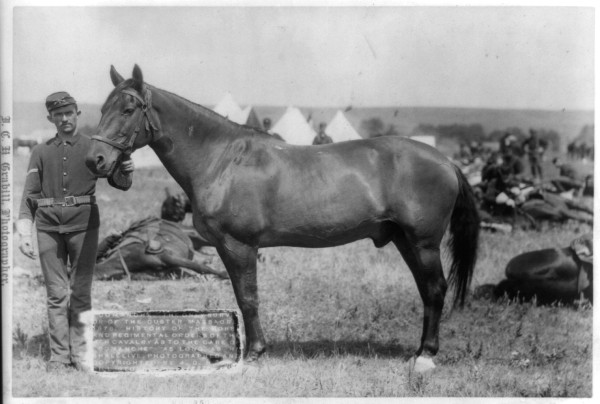
Comanche in 1887.
The inserted note reads ‘The only survivor of the Custer Massacre, 1876...’
(Photographed by John Grabill, United States Library of Congress's Prints and Photographs. Public Domain. Source: 🔗)
For those not versed in Comanche-ana, we ought to make clear from the outset: lots of living beings, equine, canine, human, survived the engagement of the Seventh Cavalry with native peoples on the northern plains on 25-26 June 1876
Approaching the battlefield on the early morning of the 25th, Custer made a critical, some say fatal, decision: he divided his forces into three battalions — under the commands of Major Reno, Captain Benteen, and himself. Reno and Benteen’s commands engaged in hard fighting, but only Custer’s immediate command, which included Comanche’s rider Myles Keogh, was wiped out.
Comanche might more aptly be called then, ‘The sole living survivor of Custer’s Last Stand.’ But was he even that?
Oh dear...
When General Terry’s relief party and the survivors of the Reno / Benteen fight arrived on the Custer battlefield on the 27th, Sgt. Charles Windolph remembered, ‘Scattered over the field were the swollen bodies of dead horses. But there were not many of them.’ Drummer Giovanni Martini concurred, ‘There were not half as many dead horses as dead men.’(2).
Custer rode his five companies into battle mounted on some 225 horses. Thirty-nine were found dead on the battlefield. What happened to the rest? (3)
.jpg)
Charles Marion Russell, The Custer Fight (1903)
(United States Library of Congress's Prints and Photographs. ID cph.3g07160. Public Domain. Source: 🔗)
En route to the battle, horses went lame and dropped of exhaustion. Historians and ex-soldiers have argued, and witnesses have attested, that due to long marches, lack of fodder and forage, lack of water, on the eve of the battle the Seventh’s horses were in a poor condition.
William Taylor, (Comp. A) stated, ‘My horse played out just after crossing the river and things looked rather dark as I trudged up the steep bluff.’
‘Soldier,’ an Arikira Scout who got left behind in the charge, came across four troopers whose horses had played out, including one who was, ‘kicking his horse and striking him with his fist,’ and later on another, ‘swearing and calling him a son of a bitch and kicking him.’
Sitting Bull said ‘The men who came with Long Hair were as good men as ever fought. When they rode up, their horses were tired and they were tired.’
Lt. Wallace (Comp. G), at the subsequent Court of Enquiry into Maj. Reno’s conduct during the battle, agrees with Sitting Bull, ‘They had been marching for three or four days, making long marches … the men were tired and the horses worn out.’ (4)
This shouldn't come as a surprise. In an army with scant regard for the welfare of its mounts, Custer stood out as a 'hard' user of horses. Of his Civil War days it was said of him, ‘Custer’s brigade are great horse killers.’ Indian fighting on the Kansas plains in the late 1860s, one of his Captains Albert Barnitz lamented, ‘Why ... march them so hard, why use up so many horses, and have to abandon forty of them, besides certain mules?’ (5)
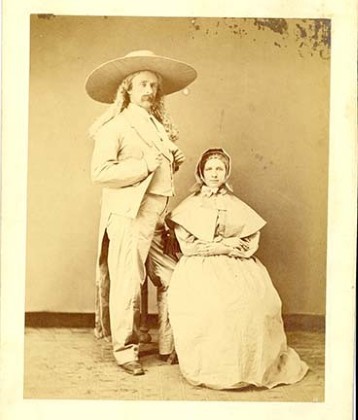
“General Custer and his Sister Mrs. Maggie Calhoun
Dressed as Quaker Peace Commissioners” (1875)
Photograph: Orlando Scott Goff.
(National Park Service, Little Bighorn Battlefield National Monument. Public Domain. Source: 🔗)
The few horses Windolph and Martini noted killed in the actual battle were not necessarily victims of Indian projectiles. As the Indians closed in, troopers shot or jugulated their mounts to form redoubts. Remember the scene in Lonesome Dove, when Gus McCrae is chased by the Comancheros? (6)
The rest would have been killed accidentally in crossfire.
Why accidentally? Because, unlike the US Cavalry, as a rule Indians did not deliberately target horses in battle — except maybe to shoot one out from under a foe to truncate bellicose intentions.
Horses were prized. Plains Indian culture was based on the acquisition and appropriation of horses. Tribes raided each other to steal horses. Horses conveyed status and power: you had a big horse herd, you were a big man. At the end of battles viable horses were taken away as trophies. The Cheyenne and Apache even observed a ‘Horse Worship’ ceremony. (7)
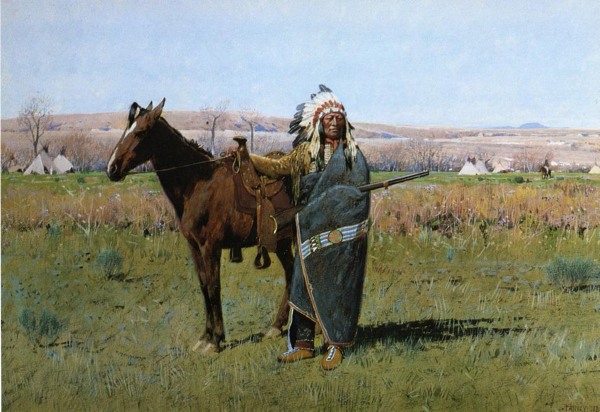
Chief Spotted Tail, painting by Henry Earny, late c19.
Spotted Tail c. 1823-1881, was a Lakota warrior and Chief
(http://www.allartpainting.com/chie-spotted-tail-p-4121.html, Public Domain. Source: 🔗)
The mindset of the US Military couldn’t be of greater contrast. Horses were a disposable commodity. You could always get more to shovel into the grinder. John Gray's article on the development of veterinary care in the US Cavalry presents some shocking statistics. (If you are empathetic to the sufferers of animal cruelty, you might want to skip the next couple of paragraphs.)
‘During the first two years of the Civil War the Union cavalry did not exceed 60,000 men; yet it consumed 284,000 horses, precious few in action.
In just the winter of 1863-1864, and within only the Union army of Tennessee, 30,000 cavalry horses perished.’ (8)
A young Civil War officer wrote home to his mother:
‘Imagine a horse with its withers swollen to three times their natural size, and with a volcanic running sore pouring matter down each side, and you have a case with which every cavalry officer is daily called upon to deal, and you imagine a horse which still has to be ridden until he lays down in sheer suffering under the saddle…
[The air] reeks with the stench of dead horses… You pass them on every road and find them in every field, while from their carrions you can follow the march of every army that moves.’ (9)
These horses were not even engaged in battle, merely marching towards it.
But if the US military held utter contempt for the welfare of its own horses, the cavalry top brass were fully cognisant of the centrality of the horse to the Plains Indians' way of life. So they effected a new policy: following victory, Indian ponies were to be slaughtered:
‘The Indians require to be soundly whipped, ringleaders... hung, their ponies killed, and such destruction of their property as will make them very poor.’ — Gen. William Tecumseh Sherman, Sept, 1868.
Custer pursued the policy with gusto. At the Washita (Nov. 1868) — after picking the best ones out for himself — the Seventh Cavalry shot, bludgeoned and slit the throats of 875 Cheyenne ponies corralled against the canyon wall. Custer could easily have allowed his men to do the dirty work, but according to Benteen who led a squadron in the action, ‘Our Chief exhibit[ed] his close sharpshooting,’ and took the opportunity to share personally in the butchery, even picking off a few Indian dogs wandering about after the human slaughter.
The 875 ponies took ninety minutes to kill.
Imagine that.
In 1874, in the eastern ramparts of the Llano Estacado (Texas), Colonel Randall ‘Bad Hand’ MacKenzie finally subjugated the Comanche. The day after The Battle of Palo Duro Canyon, MacKenzie nearly doubled Custer’s tally, ordering his 4th Cavalry to slaughter some 1500 ponies.
Bad Hand later went mad. It is not known if the two events are connected.
(10)
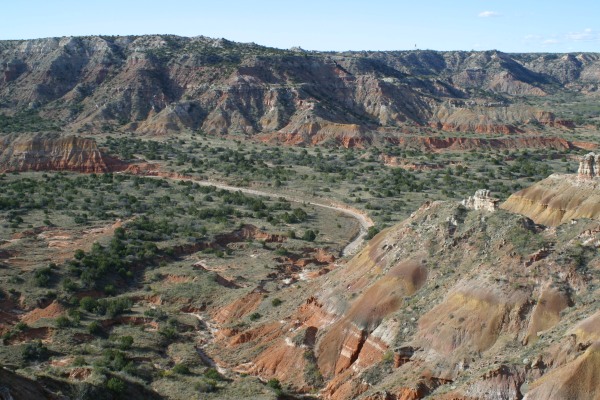
Palo Duro Canyon.
The Indian ponies were slaughtered in nearby Tule Canyon.
(Photo by Leaflet - Own work, CC BY-SA 3.0, Source: 🔗)
Back to the Native American conception of the horse, which is key to why Comanche cannot be claimed as the sole survivor. (At last — this joker is getting to the point!) Horses were so esteemed, Indians weren't leery of risking their necks to get them, even in the visceral chaos of the Battle of the Little Big Horn.
The reporter who interviewed Hunkpapa Chief Gall for The St Paul Pioneer Press in 1886 took time to note, ‘The chief’s mind seemed to particularly dwell on the number of horses they captured, rather than the terrible slaughter which took place.’ (11)
Before we progress, an expository note here. You might not know this but, rather than charging hell for leather at the enemy, sabres glinting, dirt divots flying, (unless a surprise attack on a sleeping camp like at the Washita) most cavalry fighting on the plains was done afoot, or at least one knee, with a carbine.
One trooper in four was detailed to hold horses — no easy task in the discomfiture, confusion, and panic of battle — the hapless holder in the open amid the flying ordnance. Terrorised horses simply broke loose and fled, or were scared loose by daredevil Indians waving blankets. The ‘fabulous warrior’ Gall witnessed such tactics at the Little Big Horn:
“They fought on foot. One man held the horses and the others shot the guns. We tried to kill the holders, and then by waving blankets and shouting we scared the horses down the coulee, where the Cheyenne women caught them.” (12)
Note Gall says the Indians deliberately targeted the holders. Horses then, were understandably turned loose, their former keepers no doubt diving for cover.
White Bull (Lakota) witnessed this. ‘The horses turned loose by the soldiers — bays, sorrels and grays — were running in all directions. Many of the Indians stopped shooting and chased these loose horses.’ White Bull personally bagged a dozen for himself.
As White Bull alludes, warriors broke off from the battle to take up ranching duties. Gall said, ‘As fast as the men fell the horses were rounded up and driven towards the squaws and old men who gathered them up.’ (13)
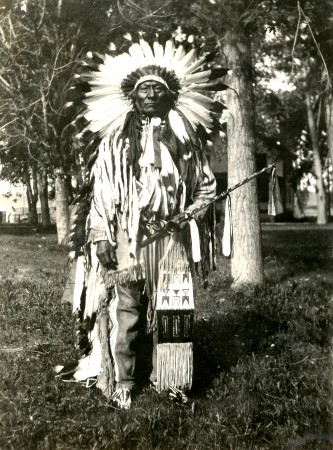
White Bull, Miniconjou Lakota, photographed in 1926,
at the 50th Anniversary of the Battle of the Little Bighorn.
(Photographed by Earl Alonzo Brininstool. Public Domain, Source: 🔗)
Kate Bighead's account (Cheyenne) tallies: ‘The horses were driven on to the river, where they wanted to go anyway, as the day was hot and they were very thirsty. They were captured by the warriors or by the women and old men.’
Lakota Chief, Runs The Enemy, helped himself, ‘The horses were so thirsty that … [at] the river they just stood and drank and drank, and that gave us the chance to get off our horses and catch hold of the bridles.’ (14)
The aforementioned poor condition of the cavalry mounts played into the Indians’ hands. Gall again: ‘Our Ponies were well rested and fast runners, but the soldiers’ horses were so hungry that they were eating grass as the battle was going on… Our braves had no difficulty in catching all the soldiers' horses.’
As for horses in Comanche’s condition, they made no great trophy and were rejected: ‘I drove five horses across the river… they were wounded and trembling. I saw they were mortally wounded and let them go.’ — Feather Earring, Lakota. (15)
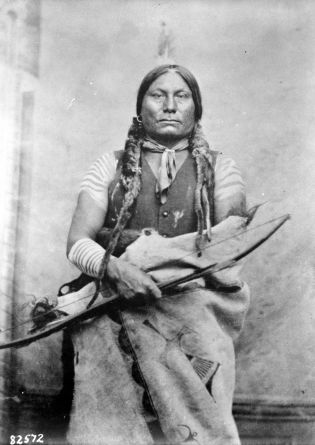
Gall (Pizi), Hunkpapa Lakota Chief, in 1881.
(Photo by David Francis Barry. Public Domain. Source: 🔗)
We know the fate of a goodly portion of these captured horses. For some, it was a quick switch of allegiance and ‘no rest for the wicked.’ When the Custer fight was over, they were rode away pronto to join the siege of Reno and Benteen’s commands.
This was a stroke of luck for Comanche who, badly wounded but not mortally so, had been rejected by the Indians. His battle was over. Who knows? He may even have been among those Feather Earring drove to the river.
Now Comanche just had to survive the ‘mercy’ of the relief party's knives, pistols and axes, maybe ending up skinned and made into a stretcher for the human decrepit. ‘A wounded horse lay near... and we knocked him on the head with a bloody ax.’ — Pvt. George Glenn. (16)
Equine prizes from the Little Bighorn were recovered from later battles, including that very same year. In September, General Crook’s revenge force destroyed a Lakota camp at Slim Buttes (now in South Dakota). As well as horses from the Custer Battle, they took back a guidon from Company I and the bloody gauntlets no less of its erstwhile leader — and Comanche's jockey — Capt. Myles Keogh. (17)
As time went by, on-their-uppers Indians traded their cherished Seventh Cavalry nags back to white society, where they were re-given white men's names, usually of one syllable.
The late summer of 1876. Crazy Horse, in council with Sitting Bull, debates what to do about the ‘everywhere’ soldiers. He makes up his mind:
‘This is the end. All the time the soldiers will keep hunting us down. Some day I shall be killed… I am going south to get mine’
Sitting Bull, he is of a different mind. North is best — to the ‘land of the Grandmother.’
The pursuing US Army's vengeance will be inexorable and adamantine. (18) You might picture the great Sitting Bull in flight, scant time to hunt, continually breaking camp, gathering up the women and children and the elderly, glancing behind.
No. Sitting Bull took his sweet time.
Meandering is an apt modifier to express his progress through the northern plains in those closing days of 1876 and early ‘77. He hunted the few remaining buffalo, drifted south, fought ‘horse soldiers’ and ‘walking soldiers,’ held councils with soldiers and allies, hunted the few remaining buffalo, drifted north.
It wasn’t until May of 1877 that he crossed the 49th parallel into the Grandmother’s Land, Canada, still in possession of quadrupedal booty from the great victory on the Greasy Grass. (19)
.jpg)
Friends now? Sitting Bull and Buffalo Bill, in 1885.
(Photograph: William Notman and Son, Library of Congress. Public Domain. Source: 🔗)
‘I saw one poor old grey horse with E7 branded on his hip, which of course meant E troop, Seventh Cavalry. I could not help patting the poor old fellow. An Indian was sitting on his back. Few… Indians have horses of this size, but in this camp, you saw the large American horses they got from the Custer fight.’
Col. Irving, Royal Canadian Mounted Police,
Wood Mountain Post, Saskatchewan.
On a visit to Sitting Bull’s Camp, 1877. (20)
Sitting Bull and some 5,000 Lakota fetched up near Wood Mountain and the Mountie Post there, the camp visited by curious Colonel Irving quoted above. In 1879 a Mountie Superintendent, a certain James Walsh, saw the ‘poor old grey horse’ branded E7, took a fancy to it, and cut a deal.
An ‘admirer of the Gallant Custer,’ a Mountie — and therefore an honest man — Walsh wrote to General Terry to ask if it was okay to keep the horse: the best of ‘many relics I have seen of the battle.’ Agreement reached, Walsh duly named it ‘Custer.’
Ironic really, Custer being such a cavalier (pun intended) destroyer of equine flesh. A bit like an Ancient Briton's favourite son being named ‘Julius Ceasar.’ Walsh must have been overjoyed when Major Reno wrote with good news: Custer had likely belonged to his hero Custer’s expunged command.
Custer, then, survived Custer’s Last Stand.
Custer the grey horse became Walsh's favourite mount and was treated by all and sundry as a war hero. But I'd doubt he got as pampered as Comanche.
After Custer the grey, we have ‘Billy’ and ‘Nap,’ likewise claimed as Last Stand survivors. These need not detain us long.
Billy, ‘The only survivor of the Custer massacre’ was discovered among the battlefield carnage, badly wounded, pawing at his master’s body, displaying the ‘pathetic mysticism’ of dumb animals. (I don’t know about you, but my nostril hairs are already twitching at such mawkishness.)
After due care and recovery, a peace officer Tom Talbot bought the horse. In performance of his duties Billy proved himself fearless, fleet and possessed of great endurance — handy qualities in the criminal apprehension business. He was also ‘gentle’ and with a ‘stately stride.’ Sounds like the perfect horse. But we are not done.
Billy was possessed of the preternatural ability to sense danger and, perhaps more importantly, the ability not to keep such intelligence to himself. A timely nicker, neigh, snort or stamp saved the sheriff’s life on numerous occasions. If Billy'd been born half a century later, Trigger wouldn't have stood a chance.
Notwithstanding the diligent efforts of researchers, no evidence exists for any of this. A bit of evidence does exist, however, apropos the character of Sheriff Tom: ‘Tom was a talker. He bellied up at the bar and told tales.’ (21)
What about Nap, another grey horse? Nap, who supposedly had his picture taken with Comanche? Could be. Probably was. But as we have already seen, lots of horses survived the battle, and this article risks getting repetitious to the point of tedium.
So sorry to break it to you, but Comanche was not the sole survivor of the Little Big Horn. He wasn’t even the sole survivor of Custer’s Last Stand.
Well how about, Comanche was the only sentient creature of Custer’s command found alive on the Last Stand battlefield. Can we have that?
Nope. A number of horses were found by Terry and Reno’s men in the aftermath. They got shot. They even got shot for being ‘played out.’ (22)
It was pure luck. Comanche had the luck to be recognised and given immediate aid by someone who knew him, Pvt. Gustave Korn (I Comp.), and who prevented him being euthanized. Comanche had the luck to be then recognized by Keogh’s great pal Lt. Nowlan, who ensured his subsequent care.
(See my blarticle, “Who Found Comanche.”)
So after all this sifting and sieving, what can we say of Comanche’s status? Can’t you leave the poor horse something, goddamnit? Well, it won’t make a great tagline, but how about going with, ‘Comanche: the only living creature of Custer’s Last Stand to make it home.’
Actually, that's not bad. (I’ll bet somebody will find something wrong with it…)
But wait!
After all this sifting and sieving, two horses remain unmentioned — and two of the most intriguing ‘lone survivor’ candidates to boot:
Custer’s favourite horse and the Cheyenne ‘Comanche.’ I’ll leave those dangling for now, and save them for another blarticle.
In his autobiography, Comanche Is Not My Name, Comanche refers to himself as ‘The one and only living survivor of the fight known as the Little Big Horn.’ But he wasn't in possession of the full particulars, laying aside the fact you can't be a dead survivor.
Anyway, here he is holding forth on the fate of the Native American. He's just been cogitating on why the Indian tribes didn't ‘cahoot up’ to defeat the whites:
‘Not that it’d made no scrap of difference in the end. The Indians was doomed the instant them pilgrims’ iron anchor plopped into that cold water. Who’d have figured folks in pointy hats and stockings and brass-buckled shoes, what didn’t even have the gumption to feed themselves, could have annihilated an entire race?
Not me.’

Notes:
1: Charles King is in Hutton, The Custer Reader, 359; Sturgis is in Lawrence, His Very Silence Speaks, 105; Excerpt from ‘Comanche the
Brave Horse’, words and music by Johnny Horton and Frances Bandy, Hi-Lo Music Inc., (1960).
2:Charles Windolph, I Fought With Custer, 110; For Martini, Camp, Custer in '76, 102.
3: Elwood L. Nye (Lt. Col.), ‘Marching With Custer’, 65; Johnston et al, Custer's Horses, 81.
4: Taylor is in Graham The Custer Myth, 344; Soldier is in Camp, 188; Sitting Bull is in Graham, 71;
Wallace is in Stiles, Custer's Trials, 445.
For more examples and comment on exhausted horses see, Camp, 126 nt, 128 nt; Johnston et al, 106, 114 (Native American accounts), 134 (Sheridan); Nye passim,
in which he argues that tired horses were a major factor in Custer's defeat.
Gray, in ‘Veterinary Service on Custer's Last Campaign,’ to some extent takes issue with Nye, but still comments, ‘The over-all average [march] amounted
to about 16 miles a day, even for the most-travelled mounts. This should impose no strain on horses given good modern care and supplied with adequate forage. But, instead, they received the army care of 1876, with forage limited by the transport facilities of the time.’
According to cavalry officer Edward McClernand, the marches on the two days before the battle far exceeded the average of 16 miles, On Time for Disaster,
The Rescue of Custer's Command, 66-7.
5: Stiles, 137; Barnitz in Utley (ed.), Life in Custer's Cavalry, 99. Examples of Custer's indifference to equine suffering are numerous:
see Stiles, 288, 290, 360; Barnitz again, in Utley, Life... 91; Utley, Cavalier in Buckskin, 52-3; Utley, Frontier Regulars, 158-9; Connell, Son of the Morning Star, 172, 238.
6: McClernand, 94; Camp, 70, 87; Nye, 65; Stiles, 451.
7: For a concise account of the plains Indians’ relationship with the horse, see Welch, Killing Custer 136-41; for horse worship:
John Stands in Timber,Cheyenne Memories, 102-3.
8: Gray, unpaginated.
9: Stiles, 98.
For comparison, during the Crimean War in the 20 minutes of the celebrated ‘Charge of the Light Brigade’ (Oct. 1854), 513 out of 673 horses were killed.
113 riders lost their lives.
Forty years after the Little Bighorn, some 485,000 horses were killed during World War I on the British side alone.
That's one for every two British soldiers killed. Only around 25% of these horses were killed by enemy fire, 'War Horse Facts' at Brooke Action for Working Horses; Brereton, The Horse at War, 96-7, 125-40.
10: Utley, Regulars, 144; Greene, Washita, 125-6; Stiles, 319; Hardorff, Washita Memories, 211; Graham, 213.
A precise number is difficult to pin down for the Mackenzie slaughter.
Wallace & Hoebel The Comanches, p.327, and Hämäläinen Comanche Empire, p.339, say 1050; The historian Dan Flores, Caprock Canyonlands, p.101, quoting a US Parks department road sign, says 1450, and later in Natural West, p.166, rounds it down to 1400. Garry Clayton Anderson, The Conquest of Texas, p.358, says 2000. I've chosen the middle ground.
11: Graham, 91.
12: Graham, 89, 92; Rickey, Forty Miles a Day On Beans and Hay, 275, 289; Jerome A. Greene, Lakota and Cheyenne 45, 61, 70; Nye, 65.; Connell, 379.
13: Hutton, 341, 344; Graham, 88; Greene, Lakota, 52, 53; Connell on Gall is a great piece of writing. Referring to a photograph of Gall he writes,
‘Even in pudgy middle age Gall was a man of such explosive strength, he fairly cracks the photographer’s glass.’ 376.
14: Hutton, 370; Johnston et al, 113.
15: Johnston et al, 106; Graham, 97.
16: Camp, 116, 126nt, 136, 226.
17: Finerty, Warpath and Bivouac, 191; Nye, 68; Utley, Regulars, 270-1; Greene, Lakota, 85;
Vestal, Sitting Bull, Champion of the Sioux, 184-9.
18: Take that, AI!
19: Vestal, 181-2, 206-7.
20: This quotation and subsequent information on the grey horse is taken from Lawrence, 29-30.
21: Lawrence, 33-4.
22: Camp, 126 nt.
Sources:
Gary Clayton Anderson, The Conquest of Texas (2005)
J. M. Brereton, The Horse at War, (1976)
Walter Camp, Custer in '76, ed. Hammer (1976)
‘Cavalry Horses,’ True West Blog,
June 22, 2020 (Accessed 01, 2026)
Evan S. Connell, Son of the Morning Star (1985)
John F. Finerty, Warpath and Bivouac (1890) (Kindle ed.)
Dan Flores, Caprock Canyonlands (1990)
Dan Flores, The Natural West (2001)
W. A. Graham, The Custer Myth (1995)
John S. Gray, ‘Veterinary Service on Custer's Last Campaign,’ Kansas History: A Journal of the Central Plains, Autumn 1977 (Vol. 43, No. 3),
pp. 249 to 263. Available here. (Accessed 02.2026)
Jerome A. Greene, Battles and Skirmishes of the Great Sioux War (1993)
Jerome A. Greene, Lakota and Cheyenne (1994)
Jerome A. Greene, Washita (2004)
Pekka Hämäläinen, Comanche Empire (2008)
Richard G. Hardorff, Washita Memories (2006)
Paul Andrew Hutton (ed.), The Custer Reader (1992)
Johnston, Fischer and Geer, Custer's Horses (2001)
Elizabeth Atwood Lawrence, His Very Silence Speaks (1989)
Edward J. McClernand, On Time for Disaster, The Rescue of Custer's Command (1969)
Elwood L. Nye (Lt. Col.), ‘Marching With Custer’ (1941), in Johnston, Fischer and Geer.
Don Rickey Jr., Forty Miles a Day on Beans and Hay (1963)
David L. Spotts Campaigning With Custer 1868-69 (1928)
John Stands In Timber, Margot Liberty Cheyenne Memories (1967)
T. J. Stiles, Custer's Trials (2015)
Robert M. Utley, Frontier Regulars (1973)
Robert M. Utley, ed., Life in Custer's Cavalry (1977)
Robert M. Utley, Cavalier in Buckskin (2001)
Stanley Vestal, Sitting Bull, Champion of the Sioux (1957)
Wallace & Hoebel, The Comanches (1952)
'War Horse Facts', Brooke Action for Working Horses,
(Accessed 03.26.)
James Welch, Killing Custer (1994)
Charles Windolph, I Fought With Custer (1987)