Who Found Comanche the Horse on the
Little Big Horn Battlefield?
(You'll find this page uses semantic, syntactic, stylistic and grammatical idiosyncrasies, colloquialisms and humour, to distinguish the human William Fagus from AI generated content.)
‘We went down into the ravine to look for Custer.
Standing alone on the battlefield, bleeding, dying from six bullet wounds in his side, was the horse Comanche.’ (nt. 1).
Pvt. Gustave Korn
Comp. I, 7th US Cavalry
May 21, 1888
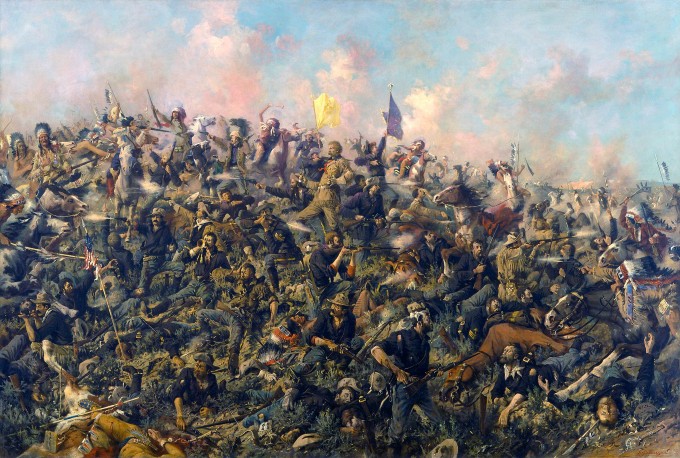
Custer's Last Stand, Edgar Samuel Paxson (1899)
(Image: Buffalo Bill Centre of The West, Public Domain, via Wikimedia Commons. Source: 🔗)
Prussian Émigré Gustave Korn must have wished he was back home at his clerk's desk in Silesia. Yet here he was in the maelstrom of the Little Big Horn, in a strange land, fighting people who’d personally never done him any harm, trying to stay aboard a fractious horse.
Lucky for us he was there, and that he survived, because he knew the horse Comanche and went on to care for him. How so? Korn was a private in Company I, Seventh US Cavalry. Captain Myles Keogh commanded Company I, and Keogh rode Comanche on the day of the battle. The three have a closer connection: it seems Korn was an orderly to Keogh. Because of his daily duties, then, Korn would be well acquainted with the horse.(2).
Later Korn, by then a farrier to Company I, was appointed a personal attendant to the pampered ‘lone survivor’ now celebrity Comanche, such that when Korn was killed at Wounded Knee, Comanche lost the will to live.
So, Gustave Korn: one of very few survivors of Company I that day, Keogh's orderly, and finder of the gallant horse on the battlefield. How appropriate. I can clap the dust off my hands and write another blog.
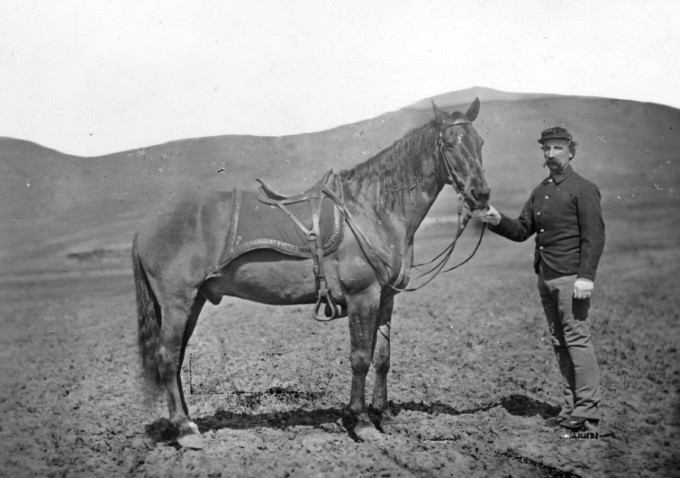
Not so fast. You could assemble a decent sized football team, including substitutes, of those who claim to have found Comanche on the Little Big Horn battlefield in the days following. And their accounts – let's be kind here – are at considerable variance.
(To enjoy this article you might find the NPS Little Bighorn Battlefield Map handy)
Thus, a young officer in General Terry's command, Edward J. McClernand relates in his memoirs that on the 27th he sighted an American horse near the deserted Indian Village, and, ‘As my horse was thin and weak, I galloped over ... intending to transfer my saddle to him, but found he had been wounded and unserviceable.’ He surmised, ‘This was probably Comanche.’ (3).
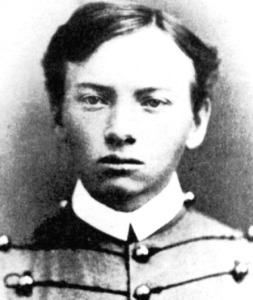
Edward J McClernand as a young man, around 1870.
(Image: Medal of Honor Recipient Edward J. McClernand, Congressional Medal of Honor Society. Source: 🔗)
Pvt. Dennis Lynch (Comp. F) speaking in 1908 said, ‘Comanche stood on Custer Hill near where the monument is with head drooped. Shot five times. He recognized his friends. When men came up and called him by name he nickered.’
Corporal John Hammon (Comp. G) agreed on this location, but oddly, in an account of the fight given just a year later, Lynch changed his mind,
‘Comanche was found down near mouth of a deep gulley, a little way back from the river.’
What are we to make of that. Maybe he'd read Korn's account. (4).
Lynch does give details of Comanche's wounds: ‘Shot in the chest and came out left side. Shot just above the hoof... Shot twice in the neck.
Shot though loins.’
Lieutenant Henry J. Nowlan ordered Lynch to dress the wounds, Lynch reporting, ‘Dressed with zinc wash on 28th.’
Agreeing with Korn as to location if not condition, in 1878 the Bismarck Tribune reported that Sgt. Milton J. Delacy (Comp. I) had found Comanche in a ravine, ‘where he had crawled, there to die and feed the crows.’ (5).
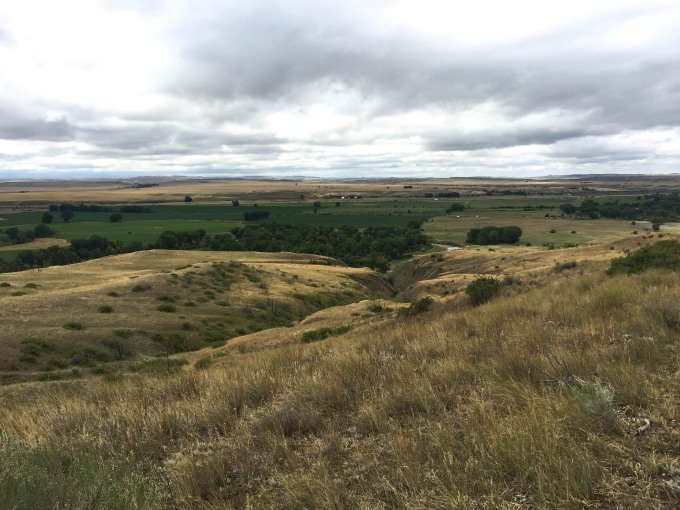
Little Bighorn Battlefield, Ravine leading down to the Little Big Horn River
(Image: NPS / Victoria Stauffenberg, Public domain. Source: 🔗)
The accounts of other witnesses, Cpt. Thomas McDougall (Comp. B), and a Trooper Ramsey (Comp. I, probably Pvt. Charles Ramsey), agree with McClernand. They each say they found Comanche on the west side of the Little Big Horn river, in or near the Indian village, McDougall reporting, ‘I took my Troop B to the Indian village to look for implements to use in burying the dead. Upon crossing the river I found Keogh’s horse in the small bushes.’ (6).
There's a problem here. Keogh was killed with the remnants of his company on the ridge, a little to the east of where Custer made his last stand, in a subsidiary Last Stand of his own. For Comanche to be discovered west of the river, in or near the Indian camp, we must accept certain assumptions.
We must accept that, in a badly wounded state, Comanche picked his way through the battlefield over rough terrain the three-quarters of a mile down to the river. Admitted, that’s not a preposterous assumption: the horses on the day, Comanche no exception, were mad with thirst, and anyway Comanche had a day and a half to stumble down there. (7)
But why would he then leave the delicious, balming water and proceed on to the Indian village? Reno and Benteen’s commands were still fighting for their lives back on the hill. Surely he'd find all the Indian fighters rushing back and forth from the village to enjoy the fight a good bit disconcerting.
Well, how about: the Indians took him to the camp as booty?
Hardly likely. In his enfeebled state he’d be no status-boosting prize. ‘Hey fellas - look what I got!’ Cue snorts of derision.
Now having said all that, an explanation does exist as to why Comanche might have been ‘found’ in the Indian camp. We’ll come back to that shortly.
Sundry final comments as to the location: Remember trooper Ramsey finding Comanche across the river? Well, shortly you discover Ramsey with Korn, finding him in the ravine. Or maybe Comanche wasn't found on the battlefield at all.
In 1890, former cavalry officer Charles King wrote in vigorous prose, ‘Bleeding from many wounds, weak and exhausted, with piteous appeal in his eyes, there came straggling into the lines some days after the fight Myles Keogh's splendid sorrel horse Comanche.’
Shortly after the battle, a newspaper reported that, ‘[Comanche] was found a day's journey from the scene of the battlefield.’ (8).
Confusing isn't it. Ravine? The Indian camp. Custer Hill? Miles away? Well, for now we'll consign the exact location of crowbait Comanche to the ‘uncertain’ file. Other claimant's are untroubled by the detail.
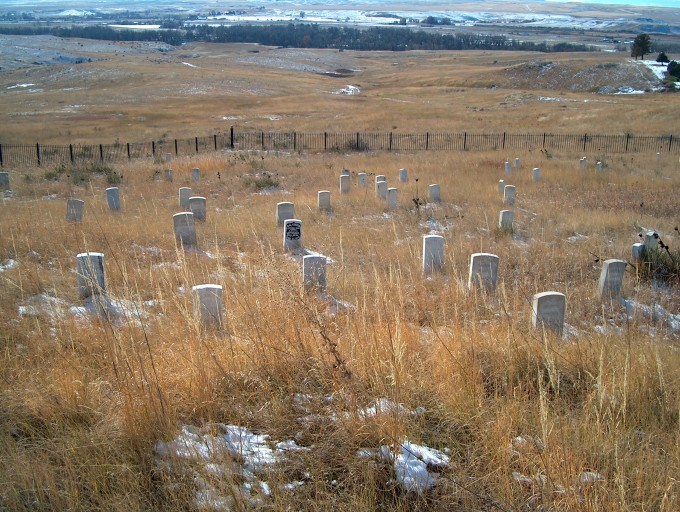
Custer Hill sloping away west to the grave markers and the Little Bighorn River and the location of the Native American encampment .
(Image: 1025wil, CC BY-SA 3.0, via Wikimedia Commons. Source: 🔗)
Private Jacob Adams (Comp. H) in his 1909 account states, ‘The only living thing on that field of death was Comanche, the favourite horse of Captain Keough [sic]. This animal was sitting on his hind parts, his front feet upon the ground. As we approached him, he whinnied. [We] dismounted and lifted him to his feet, then we rode away, leaving him feebly grazing. That night this splendid old horse, which was later to attract so much public attention, though riddled with bullets, came into camp.’
Interestingly, unlike other accounts, Adams and his comrades did not render any kind of first aid or refreshments to Comanche. (9).
By contrast Korn reports of his encounter, ‘One trooper by the name of Brown, wanted to cut Comanche’s throat to end his misery, but a trooper named Ramsey (there's Ramsey again) and myself remonstrated, and got Comanche down to the river, bathed his wounds and finally got him in condition to get on the boat.’
Trooper Brown wasn't the only finder who wanted to administer the coup-de-grace. Wounded horses were being dispatched all around Comanche. The horse had survived the battle, now he had to survive the attentions of his erstwhile comrades.
Interviewed in 1934, Henry Brinkerhoff (Comp. G), ‘An old trooper of Reno’s command’ said he found Comanche in a patch of trees 'pretty well done up.' An officer told him to shoot him, but when he went back Comanche whinnied and approached. It turned out Comanche’s wounds were not as bad as Henry first thought, so Comanche was spared. (10).
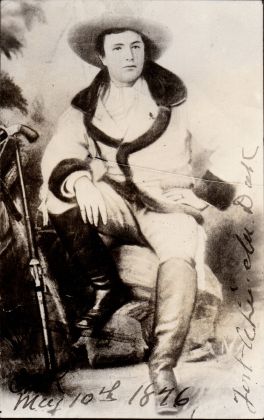
22 year-old Henry M. Brinkerhoff, photographed in May 1876,
shortly before he set off on campaign with Custer.
(Image: Henry M. Brinkerhoff, Custer Battlefield Veteran. Montana State Library, Billings Historic Photo Collection. Source: 🔗)
John C. Lockwood in his ‘Authentic History of Comanche’s Life’(1923) resisted the temptation to kill Comanche. Instead he claims to have given succour:
‘A private … James Severs, better known as Crazy Jim, and myself found Comanche, too weak to walk but with only flesh wounds. We took water in our hats and gave him a drink. He soon showed signs of regaining strength.’
In 1922, Lockwood had dictated his memoirs. There, he included the detail that Comanche was, 'lying in a bunch of dead men and horses, unable to get up until he was lifted' which adds a certain grisly colour - and no self-promoter ever lost out by adding grisly colour.
As such, Lockwood proved himself an early adopter of the selfie. In 1923 he applied to the University of Kansas to have his picture taken beside the now taxidermied horse. He was granted permission - why wouldn't you for the authentic saviour of a fallen hero's mount. But if the photograph was ever taken, it has been mislaid.
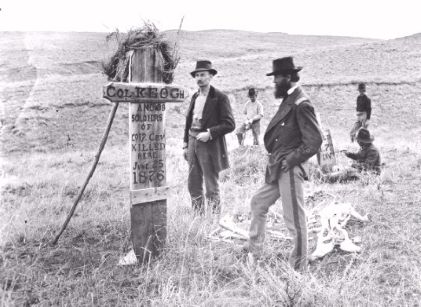
Capt. Myles Keogh in 1875, and four years later, his battlefield marker.
Note the bleached bones of dead horses.
(Images: Public domain, Wikimedia Commons. Source: 🔗)
Lockwood staked his claims, you'll note, nearly half a century after the battle, by which time most of the other combatants had been rendered mute by dint of being six-foot under. The claims were soon discredited.
Given that Lockwood didn't enlist in the Seventh Cavalry until two months after the battle, the comment of the Indian Veterans Association that
Lockwood was a man of, ‘unsubstantiated pretensions,’ seems a good bit restrained.
In the spirit of ‘never let the facts get in the way of a good story,’ Lockwood's story was republished in 1966, with the claims intact. (11).
More credible are the less egocentric words of Pvt. Theodore W. Goldin (Comp. G) written in 1921:
‘As we were moving over the field with the burial party on the 28th, one of our men discovered something moving on the hillside some little distance [away], and hurrying over soon returned with word that a horse, apparently severely wounded but alive, was over there... The poor fellow was too weak to stand, and many of the men mounted, galloped to the river and returned with water carried in their hats which was given to the poor famished horse.’
Underlining this collaborative effort, Goldin wrote, ‘Many of us went over and recognized Comanche, the favourite mount of Maj. [sic] Keogh.’
How refreshing. (12).
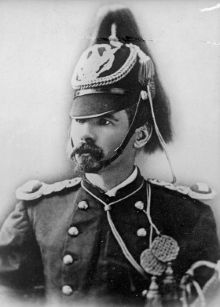
A final contender remains, even though he never personally claimed to have found the horse: Lt. Henry J. Nowlan. Given the preceding chicanery, maybe this unassuming character is worthy of serious consideration.
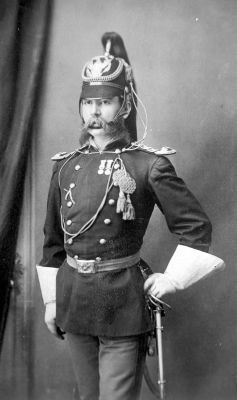
Another impressive set of whiskers, Lt. Henry J. Nowlan,
photograph taken 1874-6, possibly on the same occasion as Keogh's, above.
(Image: Denver Public Library Special Collections, Call Number B-646. Source: 🔗)
A little background is illuminating here.
Nowlan, of Irish parentage was a Sandhurst-educated career soldier. Among other conflicts, before migrating to America he fought in the Crimean War.
In 1866 he enlisted in the Seventh and soon formed a bond with fellow Irishman Myles Keogh.
In an 1867 letter to his brother, Keogh described Nowlan as ‘handsome and exceedingly passionate,’ and that they were now ‘fast friends,’ such that Nowlan was going with him to visit Ireland the next year. By 1870, Keogh was living with Nowlan, who by then was engaged to be married, ‘to a sweet girl.’
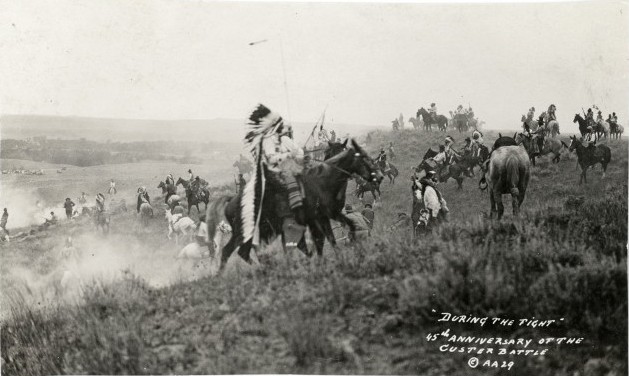
Re-enactment of the Battle, 1921, Crow Indians pictured
(Image: Montana Historical Society Library and Archives. Source: 🔗)
Before marching off to the Little Big Horn in the summer of 1876, Keogh, maybe experiencing presentiments of doom, vouchsafed his last will and testament to Nowlan. One of the beneficiaries would be Nowlan himself, to the tune of $1,000, no paltry sum - equivalent to around $31,000 in 2025. Keogh also instructed Nowlan to burn nearly all of his personal papers.
In 1890 with Comanche present, Capt. Henry J. Nowlan commanded Keogh’s old troop, Company I, at Wounded Knee. (13).
How fitting, then, if Nowlan was the finder of his dead best friend's steed.
Joseph Mills Hanson was in no doubt:
‘Lieutenant Nowlan ... was with the men gathering together the dead and discovered the horse standing in a ravine [there's the ravine again], covered with bullet and arrow wounds and half dead from loss of blood. He was instantly recognized as Comanche, the “claybank sorrel” charger of Capt. Keogh. Lieutenant Nolan caused the animals wounds to be dressed...’ (14).
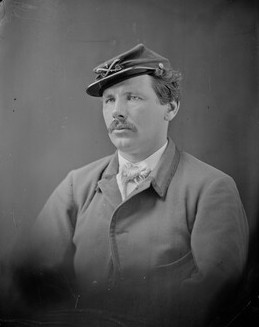
Myles Keogh, around 1869.
An image that provides more insight into this professional soldier's character
than the dress photograph above.
(Amon Carter Museum of American Art, Fort Worth, Texas. Photographed by Ebenezer E. Henry. Public domain. Source: 🔗)
Hanson's account tallies with that of former cavalryman and Comanche authority Edward Luce: ‘While the last rites were being performed on June 27th, a lone horse [Comanche] was observed by First Lieutenant Henry J. Nowlan.’ (15).
After that, things get murkier. Mills Hanson and Luce were historians. Neither were on the battlefield that day. Lieutenant Edward S. Godfrey (Comp. K) was. His diary of the expedition to the Little Big Horn is a crucial historical document. He wrote,
‘When General Terry’s troops arrived at the site of the hostile village, June 27th, Lt. Henry J. Nowlan … an intimate friend of Keogh, recognized Comanche and took him in charge.’ (16).
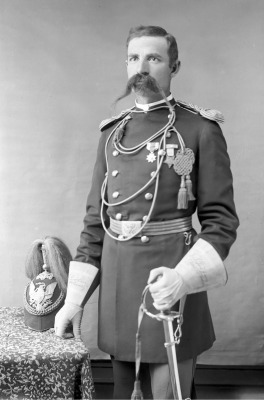
Surely the best whiskers of the lot, Lt. Edward Settle Godfrey, photographed around 1874.
(Photo by David Francis Barry, Public domain, via Wikimedia Commons. Source: 🔗)
Ahh, ‘recognized.’ It may be, then, that Nowlan was not necessarily the finder of Comanche, but the identifier. And why wouldn’t Keogh’s ‘intimate friend’ immediately recognize his horse?
This ties in with the story of our very first claimant, McClernand. If you think about it, why would McClernand, an officer of the Second Cavalry, recognise a horse belonging to the Seventh? So in a later letter, Godfrey reaffirms that Nowlan saw McClernand inspecting an injured horse as a potential replacement for his own. Nowlan became curious and rode over. Recognition ensued.
By the same token, would a trooper of the Seventh who didn't belong to Company I recognise Comanche in a regiment of 670 horses? (17).
Brinkerhoff, for example, may have found a horse, but being of Company G maybe wouldn't have recognized the horse. Nowlan later identifies Comanche, but Brinkerhoff has unwittingly found the great equine hero - for which he can gain much credit and entertain all who'll listen with the telling of it.
But at the end of all this, we still have a multiplicity of finders. How do we explain this? I mentioned chicanery earlier. Were most of these men bald-faced liars? Or can we rationalize their actions in claiming to be the finder of the famous horse, maybe make allowances.
The troopers picking over the battlefield on the 27th were in a state of shock and confusion. Add to that exhaustion for those who had survived the hilltop fight with Reno. That great Indian fighter, Custer, his command had been destroyed and was now mutilated, flyblown and festering in the summer sunshine.
Godfrey writes that as early as the 26th, ‘The stench of the dead men and horses was now exceedingly offensive … ’ and despite the threat of renewed attack, ‘... it was decided to take up new positions nearer the river.’
When Gen. Terry's relief column arrived on the 27th and the officers assembled to receive them, ‘There was scarcely a dry eye; hardly a word was spoken, but quivering lips and hearty handshakes gave token of the thankfulness for the relief and grief for the dead.’ (18)
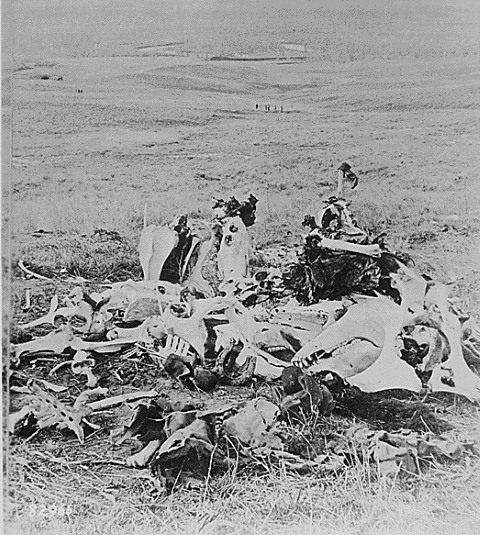
A Pile of Bones on the Little Big Horn Battlefield,
Looking West Towards the River and the Indian Village. Photographed c. 1877.
Note the horseshoe.
(National Archives and Records Administration, Public domain, via Wikimedia Commons. Source: 🔗)
So, yes. We should make allowances for these men, burying their friends, exsanguinating their crippled mounts in this ‘scene of sickening ghastly horror.’ They had bigger things on their mind. Today they would be diagnosed with post-traumatic stress disorder. So what if the misremembered the location of an injured horse as they told their stories decades later? (19)
Hmm. Decades later. I don't know about you, but I can’t give exact details of what I was doing last month, lay aside 45 years ago. Memories develop holes. The brain blots the bad out.
Okay, we have made the allowances. But what if most of them do turn out to be liars. Why do such a thing?
One simple reason might be that they thought of Comanche as a lucky charm. Comanche was the ‘only living survivor’ of the great battle. (He wasn’t, but we’ll let that be for now). A trooper must continue his perilous career in the Indian Wars. So he forms connection with the horse as a kind of protection. ‘He survived. Why can't I?’
I'll throw that one in just for openers. Elizabeth Attwood Lawrence pondered more deeply on what the motives might be:
As the ‘only living survivor’ of Custer's slaughtered command, Comanche would take on an enormous emotional significance for those humans who survived the engagement, and those of Terry’s command who buried the bodies. That ‘special significance’ only grew as the years passed.
Thus, as Lawrence puts it, ‘the surviving horse became the object of so much interest and emotion, that having discovered him was regarded as an honour, and brought considerable distinction to those who claimed it.’ Later she more pithily puts it as, ‘Comanche’s power to confer honour.’ Who of us wouldn’t want to be honoured? (20)
Human nature. We all want to thought well of. We might even want to be thought superior to our fellows.
So you're an old Private of the Seventh, nigh on half a century after the event. You've never done much with your life, bummed around from menial job to menial job, never made any money, barely got enough to pay for your funeral. Truth be told, you never really recovered from that day. Your grandchildren, they think you're a cheese-brained old fool.
Fella comes, writing a book, asks you about it, asks you about the horse.
Do we begrudge this old campaigner the honour? Do we begrudge his grandchildren the telling of the tale?
Oh yeah. Me, I found Comanche. My life ain't been such a failure.
Our trooper wouldn't be alone in wanting such honour, what me might alternatively term, an endorsement of good character.
Corporations and governments like to be thought well of too. Corporations and governments spend millions to get accomplishment and celebrity connected to their product or politics. ‘Branding’ it's called.
Why? So people will think better of them and buy their product.
So people will think their regime can’t be so evil after all.
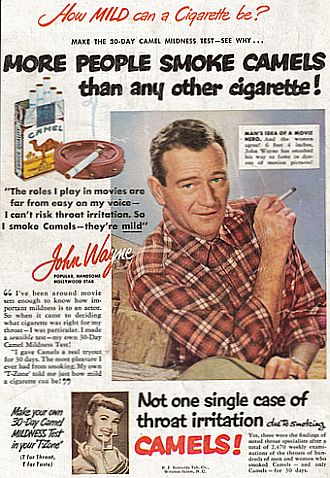
A step or two down from honour is fame. And, hard to believe I know, but some of us just want to be famous.
Comanche became famous, and, to mangle Lawrence's phrase, fame has power to confer fame. You get a simple selfie with Taylor Swift or Renaldo, the kudos can get you a couple of drinks at the bar, or add a few thousand followers to your Instagram account. Just think how many clicks you'd get if you were the finder of an indestructible horse. You'd go viral.
As the decades passed and Comanche's fame burgeoned, more old troopers showed up to stake their claims. After all, there's no fame in having saved an anonymous nag. In 1910 one ex-cavalry officer, Lt. Edward G. Mathey (Comp. M), even claimed that he, not Keogh, rode Comanche on the day of the battle. (21)
A step up from Honour is Heroism. Comanche has the power to confer heroism: Me, I saved the hero Comanche. If it wasn't for me the ‘only living survivor’ wouldn't have made it. I found him alone and crippled and bleeding amidst the putrefaction and gore. I took my hat and gave him water.
That's a hell of a thing.
Korn, he saved him twice, he found him and watered him, bathed his wounds, and stepped in when another wanted to open his jugular. Some might call that heroism.
So who really found Comanche?
Well, we've come this far so I might as well put in my fourpence / six cents worth.
Korn and Nowlan.
Korn was close to Keogh and would know the horse. He wrote his message in 1888, when there were still plenty of old cavalrymen around to disabuse him if he was merely trying to appropriate Comanche's fame and honour. But how does Nowlan fit in?
Here's a possible scenario to satisfy both contenders:
Korn finds Comanche in the ravine, recognises him and ministers to his needs down by the river, leaves him there to attend to more urgent duties.
Meanwhile serviceable horses are being assembled near the abandoned Indian village. Comanche is ‘found’ (maybe by McDougall) and taken, or wanders over there of his own volition. McClernand, fancying an exchange for his own knackered mount, checks out one of the equine assemblage. Nowlan recognises his friend's ‘sorrel charger’, investigates, and ensures subsequent care.
But I wasn't there.
If you enjoy speculation and don't want to dismiss the remaining claimants as liars, you could concoct a whole scenario in which all claims are justified:
Comanche tottering about the battlefield, sometimes recognised sometimes not, collecting hatfuls of water here and threats of early demise there, until taken into care by Nowlan. So, Lynch finds him on the hill, but must pursue more pressing duties, leaving Comanche to wander about getting ‘discovered’ by the equally busy Delacy, Adams et al, until he arrives at the village to be recognised by Nowlan. You'll note that only Korn claims to have rendered any prolonged care to Comanche.
Your turn.
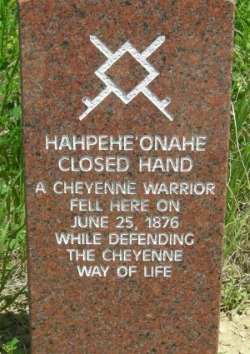
Cheyenne Grave Marker, Little Big Horn Battlefield
(Image: Wilson44691 - Own work, Public Domain, via Wikimedia Commons. Source: 🔗)

After all this extended enquiry and convoluted conjecture, of course the true identity of Comanche's finder has been available all the time - in the autobiography of the famous ‘only living survivor’: Comanche Is Not My Name.
I've redacted the name of the finder, but I guarantee it's not who you'd think it might be!
‘Now if I’d munched an apple for every trooper what claimed to be him that found me that fly-blown morning on the Greasy Grass, I have been demised by the colic by now...
[They] returned with a hat brimming with water, no wordplay intended, and a bunch of fresh grass ... must have walked a fair distance to gather. ... Held out the hat while I drank, and was right patient as I drained it, and I tell you it were the sweetest most quenchsome water I ever tasted in my earthly, though I couldn’t swear it were untainted by the juice of life. ’
Notes:
1: Korn wrote this in 1888 while serving at Fort Meade, Dakota Territory, on the back of a large photograph, Lawrence, His Very Silence Speaks, 75.
2: Winkler, ‘The Case for a Custer Battalion Survivor: Private Gustave Korn’s Story,’ 78. Korn was from the town of Szprotawa, which is now in western Poland.
3: McClernand, On Time for Disaster, 59.
4: Camp, Custer in '76, 139, 140; Lawrence, 77.
5: Lawrence, 78
6: Graham, The Custer Myth, 377; Lawrence, 77; Camp, 73.
7: Camp, 95 nt. 15, 121; for thirsty horses, 58; Panzeri and Hook, Little Big Horn 1876, 74-6.
8: In Hutton, Custer Reader, 359; Lawrence, 77. Lawrence's reference to this newspaper is uncharacteristically vague.
9: Jacob Adams, A 7th Cavalry Survivor's Account of the Battle of the Little Bighorn;
Adams gives a slightly different account in Camp, 121; Lawrence, 78.
10: Lawrence, 78.
11: Lawrence, 76-7.
12: Lawrence, 79.
13: Sources for Nowlan are Lawrence; Utley, Life in Custer's Cavalry; and Russell, "Captain Henry James Nowlan."
14: Hanson, The Conquest of the Missouri, 214.
Nowlan was not on the battlefield that day to fight and die alongside his friend. He had been attached to Terry's command and arrived as did McClernand on the 27th.
15: In Lawrence, 74-5.
16: In Hutton, 318.
17: For the number of horses in the Seventh Cavalry in the late spring of 1876, see True West Blog ‘Cavalry Horses’.
Custer was short of horses for the campaign, and some cavalrymen had to walk all the way from Fort Lincoln on the Missouri to the Rosebud.
18: In Graham, 145-6. See also the comments of interpreter Frederic Gerard, in Camp, 236-7.
19: The 'ghastly horror' words are Godfrey's, in Utley, Cavalier in Buckskin, 192.
20: Lawrence, 79-80.
21: Camp, 73, nt. 6.
Sources:
Jacob Adams, A 7th Cavalry Survivor's Account of the Battle of the Little Bighorn (1909), at
Astonisher.com (Accessed 01.2026);
Jacob Adams, The Story of the Custer Massacre (1965).
Walter Camp, Custer in '76, ed. Hammer (1976)
‘Cavalry Horses,’ True West Blog,
June 22, 2020 (Accessed 01, 2026).
W. A. Graham, The Custer Myth (1995)
Elizabeth Atwood Lawrence, His Very Silence Speaks (1989)
Joseph Mills Hanson, The Conquest of the Missouri (1916)
Paul Andrew Hutton (ed.), The Custer Reader (1992)
Edward J. McClernand, On Time for Disaster, The Rescue of Custer's Command (1969)
Peter Panzeri; Richard Hook, Little Big Horn 1876 (1995)
Samuel L. Russell, "Captain Henry James Nowlan,"
Army at Wounded Knee , (Carlisle, PA: Russell Martial Research, 2015-2016), (Accessed 01.2026)
Robert M. Utley (ed.), Life in Custer's Cavalry (1977)
Robert M. Utley, Cavalier in Buckskin (2001)
Albert Winkler, ‘The Case for a Custer Battalion Survivor: Private Gustave Korn’s Story.’
Montana: The Magazine of Western History (2013). Accessed 01.2026 here